 Add to Chrome
 Add to Firefox
 Add to Edge
Fisher Decorator: Refining Flow Policy via A Local Transport Map
Apr 20, 2026
Recent advances in flow-based offline reinforcement learning (RL) have achieved strong performance by parameterizing policies via flow matching. However, they still face critical trade-offs among expressiveness, optimality, and efficiency. In particular, existing flow policies interpret the $L_2$ regularization as an upper bound of the 2-Wasserstein distance ($W_2$), which can be problematic in offline settings. This issue stems from a fundamental geometric mismatch: the behavioral policy manifold is inherently anisotropic, whereas the $L_2$ (or upper bound of $W_2$) regularization is isotropic and density-insensitive, leading to systematically misaligned optimization directions. To address this, we revisit offline RL from a geometric perspective and show that policy refinement can be formulated as a local transport map: an initial flow policy augmented by a residual displacement. By analyzing the induced density transformation, we derive a local quadratic approximation of the KL-constrained objective governed by the Fisher information matrix, enabling a tractable anisotropic optimization formulation. By leveraging the score function embedded in the flow velocity, we obtain a corresponding quadratic constraint for efficient optimization. Our results reveal that the optimality gap in prior methods arises from their isotropic approximation. In contrast, our framework achieves a controllable approximation error within a provable neighborhood of the optimal solution. Extensive experiments demonstrate state-of-the-art performance across diverse offline RL benchmarks. See project page: https://github.com/ARC0127/Fisher-Decorator.

MEMENTO: Teaching LLMs to Manage Their Own Context
Apr 10, 2026Reasoning models think in long, unstructured streams with no mechanism for compressing or organizing their own intermediate state. We introduce MEMENTO: a method that teaches models to segment reasoning into blocks, compress each block into a memento, i.e., a dense state summary, and reason forward by attending only to mementos, reducing context, KV cache, and compute. To train MEMENTO models, we release OpenMementos, a public dataset of 228K reasoning traces derived from OpenThoughts-v3, segmented and annotated with intermediate summaries. We show that a two-stage SFT recipe on OpenMementos is effective across different model families (Qwen3, Phi-4, Olmo 3) and scales (8B--32B parameters). Trained models maintain strong accuracy on math, science, and coding benchmarks while achieving ${\sim}2.5\times$ peak KV cache reduction. We extend vLLM to support our inference method, achieving ${\sim}1.75\times$ throughput improvement while also enabling us to perform RL and further improve accuracy. Finally, we identify a dual information stream: information from each reasoning block is carried both by the memento text and by the corresponding KV states, which retain implicit information from the original block. Removing this channel drops accuracy by 15\,pp on AIME24.
Learning Rollout from Sampling:An R1-Style Tokenized Traffic Simulation Model
Mar 26, 2026Learning diverse and high-fidelity traffic simulations from human driving demonstrations is crucial for autonomous driving evaluation. The recent next-token prediction (NTP) paradigm, widely adopted in large language models (LLMs), has been applied to traffic simulation and achieves iterative improvements via supervised fine-tuning (SFT). However, such methods limit active exploration of potentially valuable motion tokens, particularly in suboptimal regions. Entropy patterns provide a promising perspective for enabling exploration driven by motion token uncertainty. Motivated by this insight, we propose a novel tokenized traffic simulation policy, R1Sim, which represents an initial attempt to explore reinforcement learning based on motion token entropy patterns, and systematically analyzes the impact of different motion tokens on simulation outcomes. Specifically, we introduce an entropy-guided adaptive sampling mechanism that focuses on previously overlooked motion tokens with high uncertainty yet high potential. We further optimize motion behaviors using Group Relative Policy Optimization (GRPO), guided by a safety-aware reward design. Overall, these components enable a balanced exploration-exploitation trade-off through diverse high-uncertainty sampling and group-wise comparative estimation, resulting in realistic, safe, and diverse multi-agent behaviors. Extensive experiments on the Waymo Sim Agent benchmark demonstrate that R1Sim achieves competitive performance compared to state-of-the-art methods.
VAM: Verbalized Action Masking for Controllable Exploration in RL Post-Training -- A Chess Case Study
Feb 18, 2026Exploration remains a key bottleneck for reinforcement learning (RL) post-training of large language models (LLMs), where sparse feedback and large action spaces can lead to premature collapse into repetitive behaviors. We propose Verbalized Action Masking (VAM), which verbalizes an action mask in the prompt and enforces that the model outputs an action from the masked set. Building on this interface, we introduce iterative action-space pruning: if the target action is not sampled, we remove valid sampled actions from the mask and resample under the reduced candidate set, repeating until the target is sampled or a fixed budget is exhausted. We study VAM in chess and evaluate it under two training regimes: an engine-play regime that generates states via play against an engine opponent and a fixed-dataset regime that trains from a fixed dataset of positions with verifier scores. Across held-out chess puzzles and full-game play measured by average centipawn loss (ACPL), VAM improves learning efficiency and final performance over strong baselines, highlighting verbalized masking as a practical mechanism for controllable exploration in LLM RL post-training.
Graph Domain Adaptation via Homophily-Agnostic Reconstructing Structure
Feb 07, 2026Graph Domain Adaptation (GDA) transfers knowledge from labeled source graphs to unlabeled target graphs, addressing the challenge of label scarcity. However, existing GDA methods typically assume that both source and target graphs exhibit homophily, leading existing methods to perform poorly when heterophily is present. Furthermore, the lack of labels in the target graph makes it impossible to assess its homophily level beforehand. To address this challenge, we propose a novel homophily-agnostic approach that effectively transfers knowledge between graphs with varying degrees of homophily. Specifically, we adopt a divide-and-conquer strategy that first separately reconstructs highly homophilic and heterophilic variants of both the source and target graphs, and then performs knowledge alignment separately between corresponding graph variants. Extensive experiments conducted on five benchmark datasets demonstrate the superior performance of our approach, particularly highlighting its substantial advantages on heterophilic graphs.
Think When Needed: Model-Aware Reasoning Routing for LLM-based Ranking
Jan 26, 2026Large language models (LLMs) are increasingly applied to ranking tasks in retrieval and recommendation. Although reasoning prompting can enhance ranking utility, our preliminary exploration reveals that its benefits are inconsistent and come at a substantial computational cost, suggesting that when to reason is as crucial as how to reason. To address this issue, we propose a reasoning routing framework that employs a lightweight, plug-and-play router head to decide whether to use direct inference (Non-Think) or reasoning (Think) for each instance before generation. The router head relies solely on pre-generation signals: i) compact ranking-aware features (e.g., candidate dispersion) and ii) model-aware difficulty signals derived from a diagnostic checklist reflecting the model's estimated need for reasoning. By leveraging these features before generation, the router outputs a controllable token that determines whether to apply the Think mode. Furthermore, the router can adaptively select its operating policy along the validation Pareto frontier during deployment, enabling dynamic allocation of computational resources toward instances most likely to benefit from Think under varying system constraints. Experiments on three public ranking datasets with different scales of open-source LLMs show consistent improvements in ranking utility with reduced token consumption (e.g., +6.3\% NDCG@10 with -49.5\% tokens on MovieLens with Qwen3-4B), demonstrating reasoning routing as a practical solution to the accuracy-efficiency trade-off.
DGH: Dynamic Gaussian Hair
Dec 18, 2025The creation of photorealistic dynamic hair remains a major challenge in digital human modeling because of the complex motions, occlusions, and light scattering. Existing methods often resort to static capture and physics-based models that do not scale as they require manual parameter fine-tuning to handle the diversity of hairstyles and motions, and heavy computation to obtain high-quality appearance. In this paper, we present Dynamic Gaussian Hair (DGH), a novel framework that efficiently learns hair dynamics and appearance. We propose: (1) a coarse-to-fine model that learns temporally coherent hair motion dynamics across diverse hairstyles; (2) a strand-guided optimization module that learns a dynamic 3D Gaussian representation for hair appearance with support for differentiable rendering, enabling gradient-based learning of view-consistent appearance under motion. Unlike prior simulation-based pipelines, our approach is fully data-driven, scales with training data, and generalizes across various hairstyles and head motion sequences. Additionally, DGH can be seamlessly integrated into a 3D Gaussian avatar framework, enabling realistic, animatable hair for high-fidelity avatar representation. DGH achieves promising geometry and appearance results, providing a scalable, data-driven alternative to physics-based simulation and rendering.
FRESA:Feedforward Reconstruction of Personalized Skinned Avatars from Few Images
Mar 24, 2025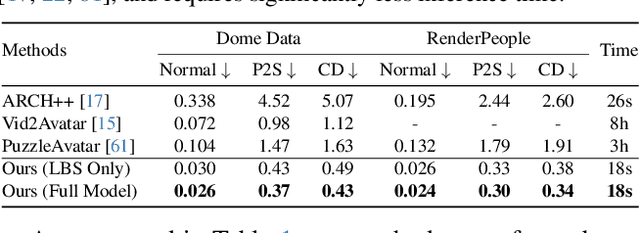
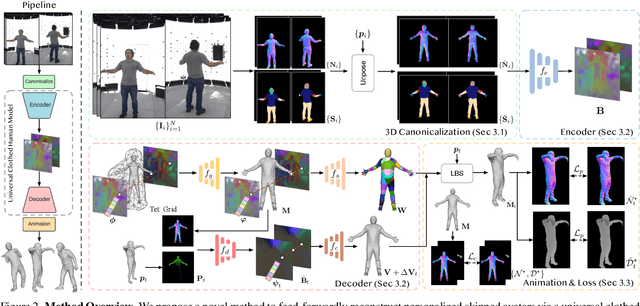
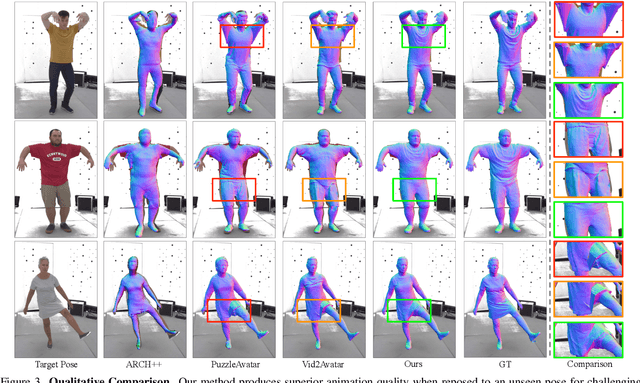
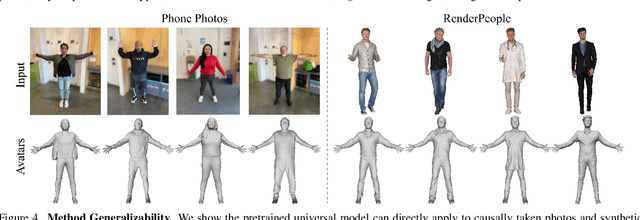
We present a novel method for reconstructing personalized 3D human avatars with realistic animation from only a few images. Due to the large variations in body shapes, poses, and cloth types, existing methods mostly require hours of per-subject optimization during inference, which limits their practical applications. In contrast, we learn a universal prior from over a thousand clothed humans to achieve instant feedforward generation and zero-shot generalization. Specifically, instead of rigging the avatar with shared skinning weights, we jointly infer personalized avatar shape, skinning weights, and pose-dependent deformations, which effectively improves overall geometric fidelity and reduces deformation artifacts. Moreover, to normalize pose variations and resolve coupled ambiguity between canonical shapes and skinning weights, we design a 3D canonicalization process to produce pixel-aligned initial conditions, which helps to reconstruct fine-grained geometric details. We then propose a multi-frame feature aggregation to robustly reduce artifacts introduced in canonicalization and fuse a plausible avatar preserving person-specific identities. Finally, we train the model in an end-to-end framework on a large-scale capture dataset, which contains diverse human subjects paired with high-quality 3D scans. Extensive experiments show that our method generates more authentic reconstruction and animation than state-of-the-arts, and can be directly generalized to inputs from casually taken phone photos. Project page and code is available at https://github.com/rongakowang/FRESA.
M3HF: Multi-agent Reinforcement Learning from Multi-phase Human Feedback of Mixed Quality
Mar 06, 2025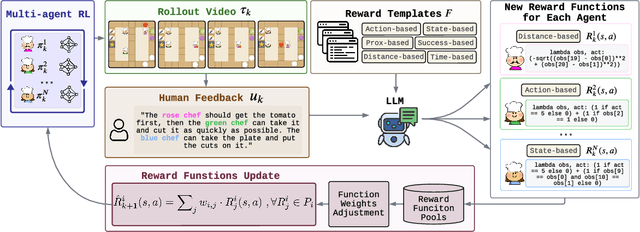
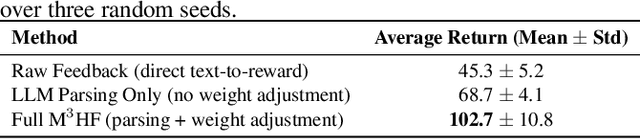
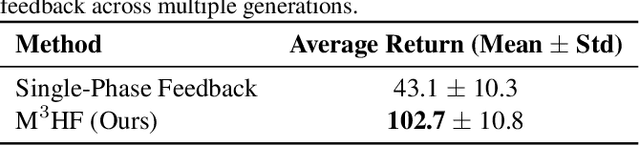
Designing effective reward functions in multi-agent reinforcement learning (MARL) is a significant challenge, often leading to suboptimal or misaligned behaviors in complex, coordinated environments. We introduce Multi-agent Reinforcement Learning from Multi-phase Human Feedback of Mixed Quality (M3HF), a novel framework that integrates multi-phase human feedback of mixed quality into the MARL training process. By involving humans with diverse expertise levels to provide iterative guidance, M3HF leverages both expert and non-expert feedback to continuously refine agents' policies. During training, we strategically pause agent learning for human evaluation, parse feedback using large language models to assign it appropriately and update reward functions through predefined templates and adaptive weight by using weight decay and performance-based adjustments. Our approach enables the integration of nuanced human insights across various levels of quality, enhancing the interpretability and robustness of multi-agent cooperation. Empirical results in challenging environments demonstrate that M3HF significantly outperforms state-of-the-art methods, effectively addressing the complexities of reward design in MARL and enabling broader human participation in the training process.
$\text{M}^3\text{HF}$: Multi-agent Reinforcement Learning from Multi-phase Human Feedback of Mixed Quality
Mar 03, 2025Designing effective reward functions in multi-agent reinforcement learning (MARL) is a significant challenge, often leading to suboptimal or misaligned behaviors in complex, coordinated environments. We introduce Multi-agent Reinforcement Learning from Multi-phase Human Feedback of Mixed Quality ($\text{M}^3\text{HF}$), a novel framework that integrates multi-phase human feedback of mixed quality into the MARL training process. By involving humans with diverse expertise levels to provide iterative guidance, $\text{M}^3\text{HF}$ leverages both expert and non-expert feedback to continuously refine agents' policies. During training, we strategically pause agent learning for human evaluation, parse feedback using large language models to assign it appropriately and update reward functions through predefined templates and adaptive weight by using weight decay and performance-based adjustments. Our approach enables the integration of nuanced human insights across various levels of quality, enhancing the interpretability and robustness of multi-agent cooperation. Empirical results in challenging environments demonstrate that $\text{M}^3\text{HF}$ significantly outperforms state-of-the-art methods, effectively addressing the complexities of reward design in MARL and enabling broader human participation in the training process.